 <![endif]>
Chapter 33
Trunk of Steele
<![if !vml]><![endif]>
|
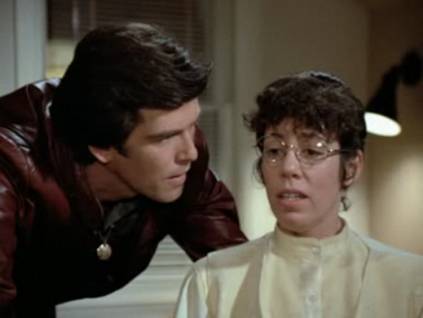
Many TV shows and movies grow like branches of a tree from the writing team of Fuhrman and Hart. Remington Steele starring Pierce Brosnan and Stephaney Zimbalist has it all with guest stars like Moonlighting’s Allyce Beasley |
|
Any unique combination of characteristics will do the same job as fingerprints or DNA in separating one person from everyone else on the planet. You can do this with Mark Fuhrman, Michael “Spencer” McClinton and the men who killed Robert Charles Hurd (with a hammer), Ron Goldman and Nicole Simpson by their unique combination of connections to movies and TV shows. Sounds crazy – until you take it seriously enough to look how it works, why it works and what the screenwriting partnership of Mark Fuhrman and Laura Hart beginning in 1985 has to do with it..
Robert Butler and Michael Gleason, the creators of Remington Steele, used the unique combination of characteristics principle to identify at least one movie, actor or character in nearly every episode of the series. They did it by giving the lead male character an obsession with movies. In the pilot episode they give him five passports with names of characters that Humphrey Bogart played in movies. They even slip in movie references you can pinpoint that aren’t stated explicitly if you know enough about the movie.
In one episode, for example, they do it just by naming a short, gruff, dogged, insurance claims investigator Norman Keyes. In all the movies ever made there is only one character named Keyes played by one actor who matches all of those other characteristics. That’s Edward G. Robinson as Barton Keyes in Double Indemnity (1944). James Tolkan is the Remington Steele Keyes. You might know him from the Back to the Future movie trilogy or a 1992 episode of The Hat Squad. Although he looks and sounds nothing like Edward G. Robinson, his height (5’ 6” – Robinson was 5’ 5”) and his role are enough to make the positive connection between him and Robinson in the original Double Indemnity.
In the first
season of Remington Steele, Michael Gleason went back to a Bogart movie with
In another episode where The Barefoot Contessa and T-Men are explicitly referenced, an actor named Phillip, and characters named Majak, Rakubian, Chester and Frank Bigelow give you a movie and four actors that weren’t named. The movie is D.O.A. (1950) with Edmond O'Brien as Frank Bigelow, Pamela Britton as Paula Gibson, Beverly Garland as Miss Foster, and Henry Hart as Stanley Phillips. O’Brien won an Oscar for his role in The Barefoot Contessa and Beverly Garland appeared twice in Remington Steele as Laura Holt’s mother. In Scarecrow and Mrs. King (1983-’87) Beverly Garland is Kate Jackson’s mother Dorothy.
In North by Northwest, a phone call that Cary Grant’s character attempts to make to his mother in a hotel bar and restaurant leads to bad guys mistaking him for a man who doesn’t exist. It’s no accident that the man posing as Remington Steele keeps a theater lobby movie poster of Notorious with Cary Grant and Ingrid Bergman on his living room wall along with posters from Casablanca and The Thin Man. With the stars of these movies come all the films they appeared in, which in Cary Grant’s case includes North by Northwest. Casablanca also gives you Humphrey Bogart as Sam Spade and Philip Marlowe. A Remington Steele episode called
A Steele at Any Price
with
Stefan Gierasch shows all
Bearing all of the above in mind what do you think all of the people and dates below from television have in common?
Efrem Zimbalist Jr., 1946 Richard Denning and Barbara Britton (Fuhrman’s first wife was Barbara) 1952-’54 Peter Lawford (brother-in-law of Jack and Robert Kennedy) and Phyllis Kirk, 1957-’59 Robert Wagner and Stefanie Powers 1979-’84 / 1993-’96 Stephanie Zimbalist (daughter of Efrem Zimbalist Jr.) and Pierce Brosnan, 1982-’87 Cybill Shepherd and Bruce Willis (a.k.a. Bruno), March 5, 1985-’89 Mark Fuhrman and Laura Hart (McKinny) April, 1985-July, 1994
Maybe these titles and characters will help:
Mr. & Mrs. North / Jerry and Pamela North The Thin Man / Nick and Nora Charles Hart to Hart / Jonathan and Jennifer Hart Remington Steele / Laura Holt and Remington Steele Moonlighting / Maddie Hays and David Addison
Knowing that Eva Marie Saint is the mother of Maddie Hays in Moonlighting could put you closer to the answer. Mr. and Mrs. North gives you two Norths and Phyllis Kirk in the World of His Own episode of The Twilight Zone gives you a West but you have to know more than that to get everything.
A serious student of the movies would know that The Thin Man movie (1934) with William Powell and Myrna Loy as Nick and Nora Charles and Maureen O'Sullivan as Dorothy is what all of the names and dates in the question have in common. It's the wellspring of all the TV shows, movies, actors and characters that eventually flow into Moonlighting and into Mark Fuhrman's relationship with Laura Hart.
Dorothy is the cross street of Bundy and the street where the alley behind Nicole Simpson's condo terminates. Dorothy is the lead character in The Wizard of Oz. Christopher Meloni, who plays Mark Fuhrman in Murder in Greenwich had a recurring role as a prisoner in the cable TV series Oz. Martha Moxley's mother was Dorothy.
Maureen O’Sullivan, the mother of Mia Farrow, appeared in a February 18, 1994 “reunion” episode of Hart to Hart called Home Is Where the Hart Is. On June 13, 1994, Nicole Simpson’s home is literally were the heart was in Fuhrman’s pointing finger photo. The “Mothers” poem in his Murder in Brentwood book uses the word “heart” twice. A plastic heart was found on the driveway next to Nicole's Jeep. Only the first part of the second name on the bottom of the paper can be read. It's Ali... Ali is a nickname for Alice. Mia Farrow is the title character in the 1990 movie Alice.
Fuhrman was a serious student of the movies. He lists ten movie or TV references in the index of Murder in Brentwood and makes movie and TV allusions, analogies and pointed references to movies, actors or characters in movies and TV shows in every chapter. His first reference to a movie in the index is Alice's Restaurant (1969). However, the page it takes you to refers to a restaurant by that name in Westwood where Fuhrman met with Laura Hart and a representative of Fred Dryer, the producer and star of Hunter shortly after Fuhrman’s preliminary trial testimony against O.J. in 1994.
On page 269 he says, “I met Laura Hart at an outdoor café in Westwood in 1985.” He says that he approached her because he was intrigued by her laptop computer, the first one he had ever seen.” The implication is that he just happened to meet and strike up a conversation with a woman named Laura Hart who just happened to be a screenwriter. But, given the evolution of The Thin Man’s Nick Charles to Moonlighting’s David Addison plus Fuhrman’s history, his choice of Laura Hart as a partner in fictional crime fighting makes more sense as a planned encounter on his part built on research and surveillance.
Jonathan Hart was a modern version of Nick Charles. A jewel thief, like Robert Wagner in It Takes a Thief, accidentally assumed the role of “Remington Steele,” a character with the salient traits of Nick Charles that Laura Holt invented to promote her detective agency. You would not think, at first, that Moonlighting’s rash, brash, lecherous, happily unmarried David Addison, had anything to do with the suave, happily married Nick Charles. You’d be wrong. They are polar opposites just as David Addison is the polar opposite of Maddie Hays and Laura Holt is the polar opposite of the man who assumed the identity of Remington Steele. And don't forget Remington Steele's Pierce Brosnan as Charles Lattimore in Murder 101.
You had to have seen William Powell as Nick Charles as well as Bruce Willis as David Addison to see the logical connection between them. You might make the same guess by following the progression of The Thin Man template in TV shows through the years short of Moonlighting if you know enough about the screenwriting team of Fuhrman and Hart. You can’t do it, however, unless you did know The Thin Man evolution from Nick Charles to Remington Steele and what the actors, characters and stories associated with them had to do with Mark Fuhrman and Laura Hart.
Chapter 1 of Mark Fuhrman’s Murder in Brentwood (1997) begins with this quote from Los Angeles County, Assistant D.A. Bill Hodgman: “It’s a real tragedy that we have a mountain of evidence to convict O.J. Simpson, and he walks free. Meanwhile, Mark Fuhrman, with an almost total absence of evidence against him, is convicted.”
The real tragedy is that no one in a position of influence recognized the most significant thing about the audiotapes that got Fuhrman convicted of perjury.
It was more than the fact that his frequent and casual use of the word “nigger” proved he lied under oath in O.J.’s murder trial about his use of the word. It was more than the fact that what he said and how he said it was consistent with a cop psychologically disposed to frame a black man married to a white woman for murder and to lie convincingly under oath about his involvement in the case. It was the fact that he approached the aspiring screenwriter in April, 1985 and did the interviews with her off and on until July 1994 when she was married with children and her new name was Laura Hart McKinny.
The constituents of that relationship are consistent with the "mountain of evidence" against O.J. left by the killer and found by or photographed with Fuhrman, starting with the knit cap like the one O.J. wore in The Naked Gun: From the Files of Police Squad!.
Every significant element on the June 13, 1994 Brentwood crime scenes were illuminated in Mark Fuhrman’s versions of who did what, how and why by characters, props, costumes, themes and scenarios found in movies and TV shows. He even defended his coarse, sexist, racist, rogue cop language on the tape as “play acting,” as assuming the role of a composite character he invented for his “hard-edged” battle of the sexes inside the LAPD screenplay. Page 270 of Murder in Brentwood: “I envisioned a film with a female role-model hero, several subplots, and lots of down and dirty action.”
On page 282 of Murder in Brentwood, Fuhrman describes where he was coming from with his approach to the Laura Hart tapes this way: “In the 1990s, people respond to NYPD Blue and Homicide and characters like Andy Sipowicz, a tough, trouble man who makes mistakes but has a good heart, who’s trying to do an almost impossible job and somehow, keep his life together.”
Two big things are wrong with those comparisons.1) Neither NYPD Blue nor Homicide went on the air until eight years after Fuhrman started making the tapes with Laura Hart. 2) NYPD Blue's Andy Sipowicz was not the racist, sexist, physically and verbally abusive cop on the 1985-1988 tapes that Fuhrman said in his first book that he was pretending to be. It was a character on Hill Street Blues named Norman Buntz played by Dennis Franz from 1983 to 1987. Dennis Franz is the actor, who played Andy Sipowicz. Other Dennis Franz movies and characters that were echoed in Fuhrman stories about O.J. Simpson are numerous. Hill Street Blues links to Remington Steele are also numerous.
Fuhrman regaled Laura Hart with stories of his exciting adventures doing the down and dirty work of real cops, harassing and beating “niggers,” summarily executing gang members, cop killers and pimps. He derisively dropped the name of the LAPD’s highest ranking female officer Margaret York whose real story had been fictionalized in the TV series Cagney & Lacey. The Men Against Women screenplay Fuhrman and Hart were supposedly working on together was a rework of Cagney and Lacey with Tyne Daly, the white actress who was married at the time to black actor Georg Stanford Brown. He was the doctor in Bullitt (’68) with Steve McQueen, the actor in the movie that Fuhrman said inspired him to be a cop.
Do you
think the branches of the tree that began with a Remington Steele trunk are starting
The point here is that during the time Fuhrman was “helping” Laura Hart with the Men Against Women screenplay, he had to know that the story had already been written and produced. He had to know who Tyne Daly was married to, what the movie links were and what they had to do with the biggest “nigger” of his recent acquaintance, O.J. Simpson. Yet, he never mentioned O.J.’s name, much less the baseball bat incident that he would write, “was indelibly pressed in my memory,” six years after his first meeting with Laura Hart.
All of the Fuhrman-related evidence and testimony in the O.J. murder case says that Fuhrman was indeed working on a screenplay – of sorts – during his partnership with Laura Hart, but not the one that she thought he was working on. He was learning the business from her, getting an inside look at the mechanics, conventions and politics of how it worked while giving her garbage. He might have gone so far as to sabotage her efforts when he thought she was getting too close to something that could sell. A Remington Steele episode called Springtime for Steele (from the plotline in The Producers) covers that scenario, too.
The killer of Ron Goldman and Nicole Simpson and his support team made these movie connections possible on the night of June 12, 1994 by the clues they left behind. They did it with the position of the bodies, the weapons, the artificial blood patterns, the evidence on the ground in Fuhrman’s pointing finger photo, and the coins in Nicole’s driveway. They did it with the stopping of Nicole’s Swiss Army watch at 10:03 and the placement of the package in the Bronco to read: Orenthal Enterprises, Attention: Cathy.
For now, we’ll concentrate on the bloody leather gloves (they come with the territory when a fighter bloodies his opponent or gets bloodied in the small confines of a boxing ring), the coins and the “Orenthal package. Franklin D, Roosevelt was the 32nd President of the United States and Lincoln was #16. One dime heads up = O.J.’s # 32 – two pennies heads up also = 32, Orenthal James Simpson).
The made for television movie connection is Goldie and the Boxer (December 30, 1979) with O.J. as boxer Joe Gallagher – alias rodeo bronco rider Joe Franklin co-produced by Columbia Pictures Television and Orenthal Productions. The assistant producer was O.J.’s personal secretary before during and after the June 12, 1994 murders in Brentwood Cathy Randa. The Cathy Randa addition to Fuhrman’s story of the Bronco puts three more Orenthal Productions movies in the kitty: Detour to Terror (’80), Goldie and the Boxer go to Hollywood (’81) and Cocaine and Blue Eyes (’82). Instead of trying to navigate the numerous links in those movies to Fuhrman’s role in the Bundy murders, think of them simply as indications that he saw them shortly before and during the time he was on leave from the LAPD and that they impressed him deeply. In trying to persuade LAPD psychologists that his stress disability claim was valid, Fuhrman used the same brutal, racist language that he used on the Laura Hart tapes. On page 274 of Murder in Brentwood, writes about meetings with “a producer” (he doesn’t say movie or television) that Laura Hart wanted him to attend. He writes, “I was on stage...I gave them the Dirty Harry meets Attila the Hun routine.” That act with producers describes his act with LAPD psychologists right down to the Dirty Harry exercise regimen and sex life to Attila’s wanton killing and maiming. The thing he left out of his free time on leave was the time he spent watching television.
Murder in Brentwood tells
you that Mark Fuhrman watched a lot of television, a lot of
Hart to Hart happens to have a direct link to O.J. Simpson in the character Max, the Harts’ cook, butler and chauffeur, Max. Lionel Stander is Max. He’s Max the train conductor in The Cassandra Crossing with O.J. Simpson.
Every chapter in each Smoking Gun book features a branch of Fuhrman-related stories in a movie or TV show with branches of other movies and TV shows attached to it. You still need Matlock, The Twilight Zone, Start Trek. Start Trek: Deep Space 9, Magnum, P.I. and Get Smart to reach all of the Strange Fruit hanging from this tree with a trunk of Steele. They're all there in words, action and song. You just have to know how to find them in the eclectic work of Billie Fuhrman's son Mark. They all bear his unique signature. --Jasper .
|
 the name "Cairo" and the pursuit of priceless treasure by a portly villain named Gutman. Steele does not see The Maltese Falcon parallel.
As always when the movie is not named he misses all of them crammed into a second season episode called
the name "Cairo" and the pursuit of priceless treasure by a portly villain named Gutman. Steele does not see The Maltese Falcon parallel.
As always when the movie is not named he misses all of them crammed into a second season episode called


