


|
|
|
|
|
"Twenty Two" <![if !vml]>
The 1978 remake of Invasion of the Body Snatchers stars Donald Sutherland as Matt Binnell and Brooke Adams as Elizabeth Driscoll. When an unidentified man comes running into traffic, scaring Matt and Elizabeth out of their wits, we know that the man is from another movie and another time. Kevin McCarthys best known role has to be
Dr.
Dr. Binnell rouses his old friend and fellow doctor Dan Kauffman from sleep to find out whats behind the shocking appearance of a dead body. Kauffman is a psychiatrist played by Larry Gates, a name that combines one of Mark Fuhrmans favorite athletes, Larry Bird, with his top cop, former LA Police Commissioner Daryl Gates. To fully appreciate what that means you have to know that Fuhrman was also Chief Gates idea of an outstanding cop. And you have to know some details about Fuhrmans observations at Bundy and Rockingham that he stressed in his book. Fuhrman begins chapter two of Murder in Brentwood with a phone
call from his old friend and fellow cop, Ron Phillips that roused him from sleep. At Bundy
When Fuhrmans investigation moved to Rockingham, he noticed
O.J.s Ford Bronco parked at an extreme angel to the curb. He theorized that a piece
of wood on the parkway in front of the Ford was dislodged from the grill or Fuhrman has O.J. heading for his front door, thinking better of it, then going in through the side and down to the basement to take off his clothes. Binnell runs from his hastily parked car in his bedclothes. He heads for the front, thinks better of it, goes to the side. You see the bottom of his slipper kicking out a basement window. You see him enter the house through the side basement window. In one paragraph of Murder in Brentwood, Fuhrman noted the
parking angle of Thats what Invasion of the Body Snatchers was really about. And that goes a long way toward explaining way I saw Gene Hackmans character Popeye Doyle in Fuhrmans book where it doesnt exist. The composite character he created for himself on the McKinny tapes describes the Hackman character in The French Connection, but does not name him. Fuhrman's description of the Bronco has much more In Invasion of the Body Snatchers, Dana Wynter plays Becky. Because its fashionable to wear black gloves to a nightspot with Miles, she wears them. When Miles takes her and his black bag to Jacks where the body is, she loses them. This is a movie you can watch a dozen times and see something newer and scarier each time. After reviewing Mark Fuhrmans part in the O.J. Simpson case, view it again. Youll see more. The first time through, you think nothing of the people Dr. Binnell meets when he comes home from a business trip and lands on the tail end of a plague thats been taking over bodies for weeks. You see little Jimmy Grimaldi fleeing in terror from his mother, not caring that Dr. Binnell nearly runs him over in his car. Jimmy claims that his mother isnt who she appears to be. Surely a delusion, thinks Binnell, ignoring all of the evidence that says Jimmy might be right. He soon learns that little Jimmy isnt alone is his delusion, but in no time the afflicted ones seem to come to their senses and accept the obvious truth for what it is. Before all is said and done you know that Dr. Binnell is the deluded one. You know that theres a conspiracy to plant seeds that take over the minds of flawed human beings and turn them into perfect Republicans. Yes, Republicansbut not your average Joe kind of Republican. These are "my-way-or-no-way" kind of Joe McCarthy Republicans. In the early 50s, Wisconsin Senator Joe McCarthy nearly destroyed the country by planting the idea that anyone who didnt agree with him about anything was a Communist. Soon Republicans and Democrats alike in the Senate and the House were behaving the same way and forcing others to do likewise. You never knew from one day to the next who would turn into one of them or whether you would be forced to by a summons to appear before McCarthys Senate Committee or the House un-American Activities Committee. Life as you knew it could have ended as you slept. Invasion of the Body Snatchers was, in fact, an allegory about the ease with which McCarthyism can spread from community to community if its not recognized and taken seriously. The trouble is, it doesnt take much to convert people who are asleep to the many forms it can take. Its all about planting seeds of thought that take the individuals place in the minds of people who dont know them. Any forced compliance to any narrow set of ideas by that means is the same thing. It happens all the time. Its a theme that runs through all of my books and not even I was conscious of where it came from until I started work on this chapter. Writing is as a process of figurative bridge-building. Any coherent link from one idea to another will do. I doubt that Kevin McCarthy was chosen to play Dr. Binnell because of his name but I have no doubt that it was a consideration on some level of consciousness. When youve studied a hundred or so films, using common names, actors or themes as bridges to cross from one to the next, you see the pattern in the frequency and the specificity with which they repeat. You see it with Andy Garcia in Dead again and Jennifer 8. You see it with Sharon Stone, Brad Dourif and Kathleen Turner in several films. Sometimes you can pinpoint the moment in one film that landed an actor a part in another. Sometimes you cant know whether the actor or the idea came first but the connection is undeniable. You already know that in Mark Fuhrmans theater of the mind, you
can trace O.J.
The Twilight Zone connection to the Bundy murders was like a key that unlocked the door to Fuhrmans lack of imagination. Behind it was "a dimension of sound, a dimension of sight, a dimension of mind; a land of both shadow and substance, of things and ideas " found in Fuhrmans reports, the crime scenes, and over and over again in the movies. One half-hour, 1960 Twilight Zone episode called "Twenty
Two," written by
Remember the clown Elizabeth Powell sleeps with. You will be seeing him in another scene from Invasion of the Body Snatchers 1978 that had to come from "Twenty Two" as an homage to Serlings "Twenty Two." Remember the leather purse in Jack the Ripper placed in the same relative location as the leather glove that Fuhrman pointed to on Bundy? Hold that thought. Remember Fuhrmans ambition to be a celebrity writer and remember that we havent finished listing the elements in "Twenty Two" that crop up often in the Fuhrman-Bundy film network. It has a cyclone fence, an open gate, a shift in time, a mix of dream and reality, bugs (a slang expression), and personal items left at the scene of violent death. Rod Serling took the idea for his story from a tale by Bennett Cerf. If you had Cerfs story to compare it to you would know where Serling got his idea without being told. The films in the Fuhrman collection should tell you the same thing about Fuhrman. Elizabeth Stride was a Jack the Ripper victim. In "Twenty
Two" Exotic dancer Elizabeth Powell (Nicols)
is in a hospital having a recurring experience she cant dismiss as a dream. It
begins with her in her bed with her rag doll clown waking up to a loud, Liz runs back down the corridor in panic-driven flight. No nurse matching the description Liz gives works at the hospital. When she leaves the hospital and goes to the airport, the same sequence of events that led her to the morgue repeat themselves with only minor differences. The clown is in her trunk and shes carrying a toy leopard. Shes wearing gloves and a coat because its cold outside. The glass that breaks is another womans flower vase with no water in it. But she has the same thirst. She hears the same loud, ticking clock. She learns at the ticket counter that her flight number is 22. Fighting back panic with every step, she walks cautiously down the narrow aisle and up the stairs of the plane where a flight attendant with the same face of the nurse appears and says, "Room for one more honey." That does it for Liz. She runs screaming back to the terminal, tripping and dropping her toy leopard and her leather purse on the narrow pathway roped off from the terminal gate to the airplane stairs. The plane takes off without her. It explodes in a huge ball of flame. Rod Serling wrote "Twenty Two." He took the idea from a story by Bennett Cerf. If you had Cerfs story to compare it to you would know where Serling got his idea without being told. In retrospect, its easy to see how the elevator Liz rides by herself down to the basement can represent the stairs she walks up by herself to the airplane door. Its easy to see how an elevator, a machine that opens a door to let on passengers in one place, closes the door to go up and down and let them off somewhere else, can symbolize an airplane. Its easy to see how a nurse who wears a uniform and takes care of her patients can stand in for a flight attendant who wears a uniform and takes care of her passengers. You can see how the flight attendant could represent everyone one the doomed plane, just the flight crew, just herselfor the divine angel of death. Using those same rules of interpretation with Mark Fuhrmans story of the Bundy killings, Liz can stand for O.J., Nicole, Sydney and Fuhrman. Start with this line by Liz about her agent while shes packing her bags to leave the hospital for the airport. "Oh hes devotedto 10% commission and 12 hours sleep, every night." Liz Powell is a dancer. On the 10th of June, O.J. packed his bags to fly into LA for his daughters dance recital. He packed his bags to fly out on the 12th. Nicole Simpson loved to dance. Liz is a full-breasted, attractive, artificial blond in her 30s. The year is 1960. Liz has been dancing for 12 years and the name of the actress playing her part is Nichols. Nicole Simpsons breast augmentation surgery gave her full breasts. She was an attractive artificial blond in her 30s who died on the 12th of June. With all of this, some of you would be impressed with a Fuhrman link to "Twenty Two" only if the room number of the morgue and the doomed flight number were 32 (for O.J. or 33 for Bird). I can only remind you of the magic of minor differences and how little it takes to transform 22 into 32 or 33. If you recalled the "Twenty Two" episode from the early 60s, for instance, but werent sure of the title, you could be forgiven for thinking that it was 32 or 33. You might arrive at either number as a composite of memories about "Twenty Two" and a Twilight Zone episode from 1961 called "The Odyssey of Flight 33." One year, one digit. "Room for one more, honey." If thats not a close enough link for you, try this: Mark Fuhrmans confrontation with Judge Itos wife Peggy York cost him a 22-day suspension. He pointed out loose change on Nicoles driveway behind her garage and theorized that it came out of O.J.s pocket when he was fumbling for the keys of his Bronco to make his escape. Some police photos show two coins, a dime and a pennyeleven cents. Detective Tom Lange's report identifies two dimes and two penniestwenty-two cents. Is Fuhrmans theory the only possible explanation, or is there room for one more? Speaking of "room for one more," the number of Lizs hospital room is 305. One more gives you 306. How bright do you have to be to turn 306 into 360 as in 360 North Rockingham? Speaking of bright, Liz is extremely bright, a trait shared by O.J. and Fuhrman. Like Fuhrman she appears to be ambidextrous (she lights a cigarette with her right hand and holds it with her left). Like O.J. She is in show business. Speaking of show business, in The Naked Gun 2 ½ O.J.
performs on stage and
What does a toy leopard have in common with the knit cap left at Bundy? Not much. But a real leopard is a killer who leaves behind a bloody mess, distinctive paw prints and . Well, think of it this way, a leopard is a cat. This cat was held in the arms of a Kitten before she dropped it, and left it in her panicky flight. Cat rhymes with hat. Where theres a cat, theres cat hair. Hands, especially a mans hands are sometimes called paws. In short, a cat gives you much more symbolically of what the killer
left on Bundy "Twenty Two" was filmed in black and white. In The
Legacy a black and white
Remember the pool of blood that Nicoles body was found in at the
base of her
How about a direct link between blood and water in the same movie?
Another way The Legacy connects to the cat and
the nurse in "Twenty Two" is The foregoing would mean little except for Mark Fuhrmans association with the Bundy 22 cents, the glove, cap and heel print; his discovery of the glove on the narrow path by the cyclone fence, his version of how it got there and how he found it. He said it got there because of O.J.s panic. He said he found it by walking cautiously down the narrow pathway with the open gate of a cyclone fence at its entrance. He said the weather might have had something to do with the Rockingham glove not being dry. There is also a thing Fuhrman seemed to have with the name Adam and a tiny rag doll he appears to have placed face down on a not-so-cleaned-up bloody tile in the walkway of Nicoles condo. Fuhrman was an LA cop with personal reasons to identify with Jack Webbbadge 714and the Adam-12 series that Webb created. Webb was another Rod Serling, only he was an actor as well as a writer and an ex-marine to boot. He had also seen combat in WW II. Fuhrmans "old friend" Ron Shipp had a bit part in an episode of Adam-12. A full-page color photo in his book shows an unidentified, blue jean-clad knee in the corner of the bloody killing ground on Bundy where Fuhrman pointed to the glove. The rag doll lies one tile up and over from a note in longhand standing up where the knit cap had been. It begins with a quote. "Mothers hold their childrens hands for a short whiletheir hearts forever." It goes on to say, "God bless you both and may your mothers spirit reside in you forever "It has two first name signatures, the second of which is unreadable. The first one is Adam. One of the creepiest things about that letter is the fact that a flower has been drawn on the paper in the same colors and in the same style Fuhrman used to draw his diagram of Ron Goldmans stab wounds. On the tile in front of the letter there appears to be a three dimensional flower of the same kind as in the drawing. A cross-shaped discoloration in the paper and around the edges makes it look as though it had gotten wet around the edges when it was folded into four distinct squareslike the blood still in the tiles in the photo with some part of all four edges showing. The curled corners on the bottom of the letterwhich obscure the second signature make it appear that it was still moist when it was set up. If you laid the letter face down the position of the flower on the letter and the degree to which the bottom corners are curled back, would correspond closely to what you can see on the ground. That includes a close approximation of the watermarks to the bloodstains. The only thing missing would be the small rag doll laying face down like a dead bodyunless you count the body of the letter. Yes, we're talking about mirror images again. That letter and its mirrored image give us the water, the blood, the doll and the killer, Mark Fuhrman. Were not finished with "Twenty Two" and Invasion
of the Body Snatchers. Hes not really a clown. That just the way his rival for Elizabeths
affections likes Elizabeth follows him out of the bedroom in her bare
feet and bedclothes. She
There are too many parallels to "Twenty Two" in that sequence to even suggest that it wasnt planned that way. Elizabeth PowellElizabeth and Howellin the same bedwith a glass of water on the nightstand that gets broken? When you factor in Twilight Zone veteran Kevin McCarthy an explanation for the sequence that owes nothing to "Twenty Two" becomes exceedingly improbable. Add up all of the "Twenty Two" parallels to the Bundy-murders-according- to-Mark-Fuhrman and see how many murders in the Western Hemisphere from 1960 to 1994 come close to having as many parallels as defined by one detective. Perhaps there was a cop out there somewhere named Rob Sterling, or some such, who investigated the murder of a blonde flight attendant name Elizabeth in a hospital elevator with a dead, spotted cat laying nearby and wrote a book about it. Id count that, wouldnt you? You wouldnt even need the narrow pathway, the rubber-soled shoes, the gloves, the clock the cyclone fence, the change, the toy or any of the numbers common to the crime and the teleplay. The cop is the hard part. Right away youre limited to a small minority of candidates who could identify as strongly as Fuhrman could to a writer like Rod Serling as well as some of his more memorable characters. Putting the characters aside for a moment, you have all you can handle with the writer alone. Serling was handsome, articulate and brilliant. So was Mark Fuhrman. Serling was a member of an elite fighting force in WW II who didnt like to talk about the killing he may have done. Fuhrman was a member of an elite fighting force in Vietnam who loved to talk about killing that he may or may not have done. Serling was a celebrity screenwriter. Fuhrman worked hard to become one. Rod Serling and Mark Fuhrman shared a fascination with Hitler and everything he represented. Serling hated nazis. Fuhrman was one. |

 <![endif]>
 Miles
Binnell in the 1956 sci-fi classic movie Invasion of the Body Snatchers. To
those who dont know the doctor, he looks and sounds in the end like a raving
lunatic. By then, we know him well. We know all of the particulars that gave him the
appearance off being something he isnt. We know that the people who appear to be
perfectly normal are the ones to worry about.
Miles
Binnell in the 1956 sci-fi classic movie Invasion of the Body Snatchers. To
those who dont know the doctor, he looks and sounds in the end like a raving
lunatic. By then, we know him well. We know all of the particulars that gave him the
appearance off being something he isnt. We know that the people who appear to be
perfectly normal are the ones to worry about.  which looked like a scene
cobbled from several movies, with a heavy accent on Michael Cains Jack the Ripper
and both versions of Native Son, he determined that the killer was bleeding from
his left hand. In Kevin McCarthys Invasion of the Body Snatchers, Dr.
Binnells friend Jack and Jacks evil imposter on his bar and recreation room
pool table are bleeding from the left hand.
which looked like a scene
cobbled from several movies, with a heavy accent on Michael Cains Jack the Ripper
and both versions of Native Son, he determined that the killer was bleeding from
his left hand. In Kevin McCarthys Invasion of the Body Snatchers, Dr.
Binnells friend Jack and Jacks evil imposter on his bar and recreation room
pool table are bleeding from the left hand.  undercarriage
when O.J., in a panic from the scene hed left at the bottom of his ex-wifes
stairs, drove recklessly to the spot and came to an abrupt halt. While the 2-degree
parking angle of O.J.s Bronco could not have tossed the piece of wood where it was
photographed on Rockingham, the 30-degree angle of Dr. Binnells Ford in Invasion
of the Body Snatchers would have. You know that because you saw him drive in a
panic wearing only his PJs, his robe and his house slippers to Becky Driscolls house
with visions of her and what hed seen at the foot of her stairs. You saw how fast he
was driving, the angle at which he approached the cub and the suddenness with which he
stopped.
undercarriage
when O.J., in a panic from the scene hed left at the bottom of his ex-wifes
stairs, drove recklessly to the spot and came to an abrupt halt. While the 2-degree
parking angle of O.J.s Bronco could not have tossed the piece of wood where it was
photographed on Rockingham, the 30-degree angle of Dr. Binnells Ford in Invasion
of the Body Snatchers would have. You know that because you saw him drive in a
panic wearing only his PJs, his robe and his house slippers to Becky Driscolls house
with visions of her and what hed seen at the foot of her stairs. You saw how fast he
was driving, the angle at which he approached the cub and the suddenness with which he
stopped.  the Bronco and the blood inside and a package
with O.J.s name on it. In the 1989 movie called The Package, you see a
panic driving situation, an extreme parking angle and a sudden stop. You cant get
more extreme than a car getting blown up, flying though the air and crashing into a tree
(a piece of wood). If the blood inside of the car from the explosion and the crash
isnt enough for you, the spry of bullets that puts the blood where you can see it
ought to do it. The "package" in the movie is a code name for a killer played by
Tommy Lee Jones who assumes the identity of another man in an elaborate right-wing plot to
undermine elected government authority.
the Bronco and the blood inside and a package
with O.J.s name on it. In the 1989 movie called The Package, you see a
panic driving situation, an extreme parking angle and a sudden stop. You cant get
more extreme than a car getting blown up, flying though the air and crashing into a tree
(a piece of wood). If the blood inside of the car from the explosion and the crash
isnt enough for you, the spry of bullets that puts the blood where you can see it
ought to do it. The "package" in the movie is a code name for a killer played by
Tommy Lee Jones who assumes the identity of another man in an elaborate right-wing plot to
undermine elected government authority.  to do with Gene
Hackmans character in The Package. Hackman plays an Army
Special Forces sergeant named John Gallagher (O.J. was John Walker in Capricorn
One and Joe Gallagher in Goldie and the Boxer). Leading a patrol in Cold War
Germany. Because its Winter, hes wearing a black knit cap and leather gloves.
Because the killing occurred in his sector of responsibility, the finger of blame gets
pointed at him. The man pointing the finger is behind the killing.
to do with Gene
Hackmans character in The Package. Hackman plays an Army
Special Forces sergeant named John Gallagher (O.J. was John Walker in Capricorn
One and Joe Gallagher in Goldie and the Boxer). Leading a patrol in Cold War
Germany. Because its Winter, hes wearing a black knit cap and leather gloves.
Because the killing occurred in his sector of responsibility, the finger of blame gets
pointed at him. The man pointing the finger is behind the killing. 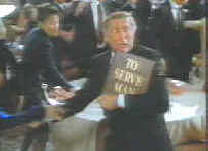 Simpsons part as the man in the blue knit cap on Bundy to the first
scene of The Naked Gun. An announcement on stage by O.J., as
Nordberg, in The Naked Gun 2 ½ sets off a panic which ties
right into a remark Fuhrman made about the chances of being kidnapped by aliens. "To
Serve Man" was the name of the episode and the name of a book, a gift with a
hidden meaning 180 degrees removed from a benign interpretation. It involved a global
kidnap scheme by a race of superior intelligent giants. Lloyd Bockner played the code
breaker in the Twilight Zone story who popped up again in The Naked Gun
spoof of him in the classic kidnap scene.
Simpsons part as the man in the blue knit cap on Bundy to the first
scene of The Naked Gun. An announcement on stage by O.J., as
Nordberg, in The Naked Gun 2 ½ sets off a panic which ties
right into a remark Fuhrman made about the chances of being kidnapped by aliens. "To
Serve Man" was the name of the episode and the name of a book, a gift with a
hidden meaning 180 degrees removed from a benign interpretation. It involved a global
kidnap scheme by a race of superior intelligent giants. Lloyd Bockner played the code
breaker in the Twilight Zone story who popped up again in The Naked Gun
spoof of him in the classic kidnap scene. Rod Serling, contains at least that many elements that repeat
themselves in the Fuhrman movie collection more often than chance
would allow. It has variations of the names: Adam (Mary Adams), John (Johnathan Harris),
Fred (Fredd Wayne) and Nicole (Barbara Nichols). It has a clown (a doll),
a cat (a stuffed toy leopard and the nickname "Kitten"), a doll
(the clown), brains, a bus, an elevator, an airplane and variations of the numbers 1,2 and
3. It has a man in a bow tie, tickets, a narrow passageway, a wheelchair, a nurse,
distinctive footsteps (the sound of a nurses shoes), rubber-soled shoes (the
nurses), breaking glass, a hat, gloves, Freud, dreams and dream-like symbolism.
Rod Serling, contains at least that many elements that repeat
themselves in the Fuhrman movie collection more often than chance
would allow. It has variations of the names: Adam (Mary Adams), John (Johnathan Harris),
Fred (Fredd Wayne) and Nicole (Barbara Nichols). It has a clown (a doll),
a cat (a stuffed toy leopard and the nickname "Kitten"), a doll
(the clown), brains, a bus, an elevator, an airplane and variations of the numbers 1,2 and
3. It has a man in a bow tie, tickets, a narrow passageway, a wheelchair, a nurse,
distinctive footsteps (the sound of a nurses shoes), rubber-soled shoes (the
nurses), breaking glass, a hat, gloves, Freud, dreams and dream-like symbolism.
 ticking
clock and a powerful thirst. As she reaches for a glass of water she knocks it to the
floor smashing it to pieces. The sound of a nurses footsteps outside her door
compels her to leave her room in her bare feet and bedclothes clutching the doll and
follow the nurse. Liz sees the woman in white on an elevator. She sees the door close and
watches the floor counter go from 3 to 2 to 1 to the ground and to the basement. Liz gets
on the elevator, goes to the basement and, shivering with cold, walks cautiously down a
narrow corridor to room 22the hospital morgue. The nurse then bursts though the
doors, looks at her and says, "Room for one more, honey."
ticking
clock and a powerful thirst. As she reaches for a glass of water she knocks it to the
floor smashing it to pieces. The sound of a nurses footsteps outside her door
compels her to leave her room in her bare feet and bedclothes clutching the doll and
follow the nurse. Liz sees the woman in white on an elevator. She sees the door close and
watches the floor counter go from 3 to 2 to 1 to the ground and to the basement. Liz gets
on the elevator, goes to the basement and, shivering with cold, walks cautiously down a
narrow corridor to room 22the hospital morgue. The nurse then bursts though the
doors, looks at her and says, "Room for one more, honey."  an admiring female fan tosses him the keys to her room. Liz is a
stripper who performs on stage. In
Fuhrmans version of the killing, O.J. wore gloves to Bundy and left them behind. In
1960, striptease dancers wore gloves just so they could take them off and toss them to
admiring fans. Fuhrman said that O.J. left the gloves and the cap behind because he was
running away in a panic and didnt realize what he was doing. Liz leaves her leather
purse and toy leopard on the narrow path between the cyclone fence and the plane because
she is fleeing in a state of panic.
an admiring female fan tosses him the keys to her room. Liz is a
stripper who performs on stage. In
Fuhrmans version of the killing, O.J. wore gloves to Bundy and left them behind. In
1960, striptease dancers wore gloves just so they could take them off and toss them to
admiring fans. Fuhrman said that O.J. left the gloves and the cap behind because he was
running away in a panic and didnt realize what he was doing. Liz leaves her leather
purse and toy leopard on the narrow path between the cyclone fence and the plane because
she is fleeing in a state of panic.  and Rockingham than Elizabeth Powells leather purse alone. When you
put the cat into the arms of Katherine Ross in The Legacy
(1979), you have it all, the link that joins "Twenty Two" to the Bundy murders
and the sequence from Invasion of the Body Snatchers that came from "Twenty
Two." You get two of Jack the Rippers victims (Elizabeth Stride and Catherine
Eddowes) who were killed on the same night, and the store where O.J. bought the Stiletto
(Ross Cutlery).
and Rockingham than Elizabeth Powells leather purse alone. When you
put the cat into the arms of Katherine Ross in The Legacy
(1979), you have it all, the link that joins "Twenty Two" to the Bundy murders
and the sequence from Invasion of the Body Snatchers that came from "Twenty
Two." You get two of Jack the Rippers victims (Elizabeth Stride and Catherine
Eddowes) who were killed on the same night, and the store where O.J. bought the Stiletto
(Ross Cutlery). image comes from a
newspaper. The one shot of a leopard skin in the entire movie is in the paper. The woman
wearing the skin is the only blond in the movie. She ends up dead in the bottom of a
swimming pool. That gives the leopard yet another meaning. Leopards are killed and skinned
by great white hunters. Mark Fuhrman was a hunter who skinned the animals he killed. He
enjoyed hunting dangers prey.
image comes from a
newspaper. The one shot of a leopard skin in the entire movie is in the paper. The woman
wearing the skin is the only blond in the movie. She ends up dead in the bottom of a
swimming pool. That gives the leopard yet another meaning. Leopards are killed and skinned
by great white hunters. Mark Fuhrman was a hunter who skinned the animals he killed. He
enjoyed hunting dangers prey.  stairs? Remember the position of her body, her bare feet and her short black
dress? In Iago I said that the killer positioned her body for the camera. I had
good reasons for saying that. The way the murdered swimmer was posed in The
Legacy is one more. The colors, shapes and locations of the patterns in the pool
are freaky enoughbut it gets freakier.
stairs? Remember the position of her body, her bare feet and her short black
dress? In Iago I said that the killer positioned her body for the camera. I had
good reasons for saying that. The way the murdered swimmer was posed in The
Legacy is one more. The colors, shapes and locations of the patterns in the pool
are freaky enoughbut it gets freakier.  Will the blood drops of a murdered woman dripping into a glass of
water do it for you? How about the blood of a murdered woman with multiple cuts and a deep
stab wound in her throat? Yes, all of this was in The Legacy. The glass of
water, you will recall, had much to do with Liz Powells premonition of death.
Will the blood drops of a murdered woman dripping into a glass of
water do it for you? How about the blood of a murdered woman with multiple cuts and a deep
stab wound in her throat? Yes, all of this was in The Legacy. The glass of
water, you will recall, had much to do with Liz Powells premonition of death. through the credits of
"Twenty Two" where Mary Adams plays an older nurse with glasses. The white cat
in The Legacy is a changeling called Adams, who doubles as a
nurse. Her glasses have a different tint for each lens to match the different color of
each eye. No one notices that the cat has the same unusual mismatch of eye colors, but at
least one person is less than thrilled with the tracheotomy Adams performs on a former
rock star with less than satisfactory results. Judging by the way she handles a knife at a
buffet table, she is most likely ambidextrous.
through the credits of
"Twenty Two" where Mary Adams plays an older nurse with glasses. The white cat
in The Legacy is a changeling called Adams, who doubles as a
nurse. Her glasses have a different tint for each lens to match the different color of
each eye. No one notices that the cat has the same unusual mismatch of eye colors, but at
least one person is less than thrilled with the tracheotomy Adams performs on a former
rock star with less than satisfactory results. Judging by the way she handles a knife at a
buffet table, she is most likely ambidextrous. We just threw in The
Legacy to strengthen the connection between them
Oh, did I mention the flowers
Elizabeth Powell had in her room along with the glass of water, the clock, the toy leopard
and the rag doll clown that she slept with? Well, she did have flowers in a vase like the
one that got smashes in the airport. But what I want you to look at now is the clown that Elizabeth
Driscoll slept with, a dentist and basketball fan named Jeffrey Howell.
We just threw in The
Legacy to strengthen the connection between them
Oh, did I mention the flowers
Elizabeth Powell had in her room along with the glass of water, the clock, the toy leopard
and the rag doll clown that she slept with? Well, she did have flowers in a vase like the
one that got smashes in the airport. But what I want you to look at now is the clown that Elizabeth
Driscoll slept with, a dentist and basketball fan named Jeffrey Howell.
 to think of him. Elizabeth thinks
hes a doll. Anyhow, the glass of water is on his side of the bed
and it has a
flower in it. The next morning when Elizabeth sees him sweeping up broken glass next to
the bed, it only makes sense that the glass is missing from the table. What doesnt
make sense is the fact that Jeffrey is up so early, fully clothed and
somehowdifferent.
to think of him. Elizabeth thinks
hes a doll. Anyhow, the glass of water is on his side of the bed
and it has a
flower in it. The next morning when Elizabeth sees him sweeping up broken glass next to
the bed, it only makes sense that the glass is missing from the table. What doesnt
make sense is the fact that Jeffrey is up so early, fully clothed and
somehowdifferent. follows him down the stairs and outside where she feels the chill
of the early morning air. To keep from being seen, she goes back to the kitchen where the
ticking of the clock is so loud its frightening. There is something a little
off-center about him but its too early for her to say that he is not who he appears
to be. She doesnt have enough to go on yet. Maybe shes the one whos a
little off center. Too bad that isnt true. Too bad the truth sounds preposterous.
follows him down the stairs and outside where she feels the chill
of the early morning air. To keep from being seen, she goes back to the kitchen where the
ticking of the clock is so loud its frightening. There is something a little
off-center about him but its too early for her to say that he is not who he appears
to be. She doesnt have enough to go on yet. Maybe shes the one whos a
little off center. Too bad that isnt true. Too bad the truth sounds preposterous. The truth is, the garbage she thinks Jeffrey
is dumping into a garbage truck is really all that remains of the Jeffrey she went to bed
with. The truth is, the garbage truck is a morgue. The only thing missing is a flight
attendant dressed like a nurse bounding through the lift gate saying, "Room for one
more honey."
The truth is, the garbage she thinks Jeffrey
is dumping into a garbage truck is really all that remains of the Jeffrey she went to bed
with. The truth is, the garbage truck is a morgue. The only thing missing is a flight
attendant dressed like a nurse bounding through the lift gate saying, "Room for one
more honey."