|
|
|
|
|
Chapter 2 Templates for Murder <![if !vml]>
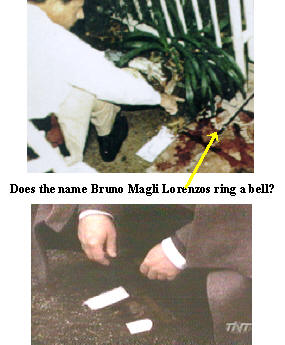
Det. Aberline (12) at the scene of Jack the Ripper’s second murder. The common thread linking all 19 items to Bundy, Rockingham and O.J. is the one woven into the public records by Det. Mark Fuhrman and his partner Brad Roberts. How can there be 19 key points of similarity in one frame of a 1988 made for British television move about Jack the Ripper to the actual crime scenes at Bundy and Rockingham? There can’t be without a killer at Bundy who was also a detective in a crime scene photo, a detective who asked that the photo be taken and pointed to the evidence at Ron Goldman’s feet. He would have to have studied those aspects of the movie frame by frame and injected them consciously and subconsciously into the clues he chose to leave behind and in the way he chose to conduct his investigation. There would be no significant connections without Mark Fuhrman’s passion for the movies, his prior contact with the female victim (8), his allusion to O.J. treating Nicole like a whore and his eagerness to be in the spotlight (19). There wouldn’t be nearly as many without his attention to detail, his study of history, his vision of himself as composite characters from the movies and his fascination with symbolism (14-see page 22). In short, to see any of those 19 connections you have to look for them through the eyes of the great detective, Mark Fuhrman. The more you know about him and the Bundy murders the more you’ll see. On Hanbury and Bundy, the victim’s door was open (1) and her body was found at the foot of the stairs. Four steps were visible (11) and several uniformed police officers (9, 6, 15) performed various tasks. The only thing that makes any of these points noteworthy is the fact that there are five “carefully arranged” items at the feet of the victim (14) all within an 8” radius of the center. This pattern was duplicated at the feet of Ronald Goldman with Mark Fuhrman’s hand marking the center of the five corresponding items. The fact that they appear in the same order, suggests that these coincidental similarities might have triggered a copy cat reaction in the killer. The fact that the items in the movie were not the same as the actual items found on Hanbury suggest that if the killer was a copy cat, he copied it from that movie. Most of the other links would disappear without Fuhrman’s claim of seeing freshly laundered clothes (10) in O.J.’s washing machine writing about his strong identification with movie characters and the characters he combined (12, 6) to play one part he called his own. Then there’s his role as the first lead detective in the picture (12), the cop (6) who found the bloody leather glove (5-bloody leather apron) on a narrow path (3-a narrow bench) next to Kato Kaelin’s wall (4). There’s the matter of his interrogation of Kaelin (13) about the time he heard the thumps. There wouldn’t be as many connections without his proof of where the stick (7-an old fence) in front of O.J.’s Bronco came from (2-an alley in a run-down part of town a few blocks away). If that isn’t enough for you, what do you think a man obsessed with O.J. and details and the 1988 release of The Naked Gun would have done with the early morning date 8th September 1888? That would be the 7th day of the 9th month San Francisco time—7/9. Consider the fact that O.J.’s birthday is July 9 and he was born in Francisco (west cost, USA). Another way we write that date in the United States is 7/9. The English put the day ahead of the month when representing the date by numbers. You’d have to be thinking O.J. all the way to pick up on details like that. <![if !vml]>
One police officer in the
picture (15) is wearing brown leather gloves, which
<![if !vml]> <![if !vml]>
Also missing from the suspect’s head
is an appreciable amount of hair. He has that in common with another
suspect, an American actor (Armond Assanti) playing Jekyll
and Hyde on stage. Wait till you see what’s lying at the feet of
<![if !vml]> <![if !vml]>
<![if !vml]> <![if !vml]>  <![endif]> <![endif]>

Let’s put the record in order: · In 1975 Fuhrman leaves the Marine Crops and joins the LAPD. His first supervisor reports that his work suffers from his constant attempts to make “the big bust.” · In 1980 Fuhrman’s second wife, Janet Hackett, leaves him for another man. Fuhrman later tells police psychiatrists that if he had caught them together he would have killed them both. · Between 1981 and 1983 Fuhrman tries to get a disability retirement from the LAPD based on a stress-related disorder which manifest itself in violent dreams, violent behavior and extreme racism. · Fuhrman describes symptoms that fit the experts’ profile of the condition he claims to suffer from. The fact that his accompanying body language is out of sync with his descriptions convinces the psychiatrists that he has researched the subject well enough to believe he could fool them. They never use the word sociopath but what they do say about his manipulative, obsessive, narcissistic personality and lack of conscience matches the definition. They all agree that he is an accomplished liar. · In ’84 the department denies his claim and puts him back to work. He gets reprimanded for applying a potentially deadly choke hold to a black man for jaywalking in front of a “white” movie theater. · In February, 1985 O.J. and Nicole get married. · Two months later Fuhrman approaches screenwriter Laura Hart in an outdoor café. Casual conversation leads to their collaboration on a screenplay called Men Against Women. He tells her how much he hates black people and how good he is at setting them up. He talks of the ease with which he and his LAPD friends could kill people. · He gets into two bitter confrontations with Asian-American Judge Lance Ito’s Caucasian wife, Lt. Margaret York. The first one involves a calendar and Fuhrman snickering about “KKK” written anonymously across Martin Luther King’s birthday. The second confrontation has to do with York’s attempt, as Fuhrman’s superior officer, to reassign him. He fights the reassignment and wins through the intervention of a Police Protective League delegate, a powerful union position that Fuhrman will later be elected to. · Fuhrman begins working in a gang/narcotics unit where he performs unknown duties for the next two years. This period is smack in between official police surveillance of O.J. as a suspected drug trafficker in the early ’80s and Nicole as a suspected customer of illegal drug traffickers in the early ’90s. Covert surveillance of suspected dope dealers and users connected to drug dealers is common practice. O.J. and Nicole live in Fuhrman’s territory and there are widespread rumors that O.J. and Nicole use cocaine. O.J.’s friend, Al Cowlings is definitely a user. If AC is under police surveillance, so is Denise Brown because they are going together. Both of them visit and party with O.J. and Nicole regularly. · Fuhrman strikes up a “friendship” with Ron Shipp, a black police academy instructor in spouse abuse who has known O.J. since childhood. He will leave the force in 1989. His last assignment will be in the forgery division. Shipp frequently brings fellow officers to O.J.’s house to meet him, to play tennis on his court and to swim in his pool. Shipp is also a friend of Nicole. Because of his cocaine addiction and his ties to O.J., Nicole, AC and Denise he is vulnerable to blackmail by a narcotics cop looking the make a big bust. · Near the end of the year, Fuhrman enters the Simpsons’ Rockingham estate when O.J. does something so bizarre that it might be attributable to drugs. He’s attacking his Mercedes Benz with a baseball bat. Fuhrman can know about it only by secretly monitoring the Simpson estate or the Westec private security company. There is no record of O.J. using threatening words or making threading gestures toward Nicole and no indication that she called Westec out of fear that he was going to harm her—as opposed to the car. With no drug bust to be made and no probable cause to assume that a crime has been committed, Fuhrman has no report he can make without getting himself in trouble. The only 911 number involved is the one written on Fuhrman’s black and white squad car. · In 1986 Mark Fuhrman meets Kathleen Bell at a Marine recruiting station in Redondo Beach, about 17 miles south of Brentwood. He owns a house in Redondo Beach near the ocean and visits the recruiting station to talk to friends. When Bell compares him to one of O.J.’s closest friends, Marcus Allen, as the type of man her white girlfriend finds attractive, Fuhrman flies into a rage. He tells her about going out of his way to harass mixed couples and wishing he could commit genocide against “niggers.” · Meanwhile, Nicole’s first calls to 911 begin. They continue 3 times a year, on average until New Years day, 1989. None of the responding officers before then, Including Fuhrman, can find anything resembling spouse abuse to write in an official report. The soundness of their judgment is confirmed by the fact that none of the calls she made before 1993 identifying herself and O.J. and referring to “his record” were ever used against him in the criminal or civil case. In that tape Nicole identifies herself and we can hear O.J. ranting in the background about someone named Keith. Unlike the unidentified person who struck the unidentified woman on the '89 tape after 3 minutes of silence, the ’93 tape shows O.J. the way the people who knew him best described him when he lost his temper. It shows him talkative, profane and loud. This is what he was being so loud about. Shortly after their divorce in November 1992, Nicole phoned O.J. to come to her new place a couple of miles south of Rockingham on Gretna Green. As he approached the front door he saw her in the picture window performing oral sex on the Mezzaluna restaurant manager Keith Zlomsowitch. There were no 911 calls involving what O.J. did next because he turned around and left. O.J. had cheated on Nicole during their marriage. He had no claim on her sex life now that they were divorced. But, after seeing what he saw the way he saw it, he worried about what the children might see. He returned the next day, shook the man's hand to show that he had no hard feelings and told him and Nicole to be more discrete around the kids. O.J. had good reason to act so civilized. By the same token, Nicole had good reason to stage what O.J. thought he had witnessed because of her carelessness and to hope that he got angry enough to hit her. The prenuptial agreement she signed when she married O.J. prevented her from getting a fifty/fifty split out of a divorce. Hitting her would have broken the terms of the divorce and given her a much larger settlement. A year later O.J. got a tip that Nicole was back to her old habits with Keith Zlomsowitch. O.J. now had reason to believe Zlomsowitch was a cocaine addict and that Nicole was surrounding herself with cocaine addicts. Nicole, by all accounts, was a good mother who never did anything in the presence of the children that a good mother wouldn’t do. But she was on a dangerous track with sex and drugs. She was seeing a lot of men. A former narcotics cop named Mark Fuhrman was telling his drinking buddies in a West LA bar that he was one of them. Fuhrman, a married man with children, told them that he had seen her “boob job up close and personal.” He also gave them a preview picture of O.J. as a man Nicole was terrified of and the kind of man you wouldn’t be surprised to see as a killer. Her death and the subsequent stalker-abuser stories that Denise Brown, Ron Shipp and Faye Resnick told the world seemed to corroborate all that he’d told the cops in the bar. Like the royal subjects in The King’s New Clothes, most Americans accepted all of these stories, contradictions and all. Even the 911 call that Nicole made in 1993 and the prosecution used to show an escalating pattern of O.J.’s violence culminating in the 1994 murder, did not give us a frightened-sounding Nicole for long. She may have called because she was, indeed frightened by O.J.'s dramatic show of anger, but in the end she sounded more like a woman who had won a big argument than a victim who had narrowly escaped great bodily harm. The tape proved only that O.J. ranted and raved when he was angry, that his voice was clearly identifiable even if you couldn't understand what he was saying, and Nicole knew that she could control him by making the call. All she had to do was give her name and his and refer to his "record." The only record O.J. had in 1993 was the one Mark Fuhrman gave him in 1989 with his letter to the city attorney regarding his version of the event he said he recalled from the fall or winter of 1985. The rest is Nicole's record, a record of her calls to 911 about O.J. with no evidence that he did anything to invite them, a record that the prosecution chose not to use in making its case against O.J. the accused murderer. Thus, we have Fuhrman linked to all three of the "damning" 911 calls Nicole was alleged to have made and serving as a key player in both of the calls that prosecutors only assumed she made. Only when you play a recording of the call we know she made in 1993 over a picture of how she looked at the police station in 1989 and on the murder scene in 1994 does the ’93 call sound menacing. Only when you play back the ’89 call with a boatload of assumptions about who did what and why can it be called proof of anything that O.J. did to Nicole. Only when you discount the 100 pound maid with the Filipino accent as the caller, the screamer the slapper or the slappee, can you attribute the call and the scream to Nicole, the three minutes of silence to O.J. and Nicole and the slap to O.J. These are not rational assumptions, given the fact that: 1. Nicole and O.J. always talked when they were in the same room together venting their anger. 2. Nicole did not hesitate to identify herself and O.J. in the only sample we have of her sounding frightened of O.J. on a 911 tape. 3. Nicole hated O.J.’s maid and punched in the face in 1994. Without Fuhrman’s report no logical assumptions about O.J. beating Nicole or threatening her with great bodily harm can be made. That report represents Mark Fuhrman’s first magic trick combined with his first successful ventriloquist act. Using O.J. and Nicole as his mindless dummies he could make them appear to say anything he waned them to. Could that be why the Protective League took Fuhrman to the Magic Castle for “a first-rate magic show” after his testimony against O.J. in the criminal trial? <![if !vml]>
|
GGGGG
Contact the author: Jasper Garrison
Send comments/suggestions
to Webmaster, Charles R. Alexander
Copyright © 1999 Smartfellows Press


 <![endif]>

 <![endif]>
 <![endif]>