
Chapter 5
Give the Man a Hand

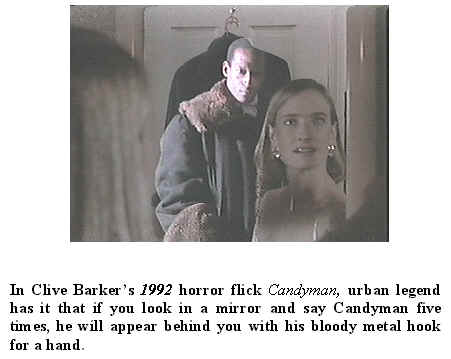
The Bundy/Rockingham jigsaw puzzle contains more than
a few pieces here
and there from stories weve seen and heard before. The pieces
 Mark Fuhrman brings
to the table invariably come in groups, each group making a complete picture of its own.
Take for example Fuhrman's "Candyman" account of the murders with the beautiful blond (1) on the
phone (2) preparing to order a take-out meal. She spots her tall, black, athletic,
pigeon-toed mate from a former life in the alley behind her garage dressed very oddly (3)
and goes to the kitchen (4) to arm herself with a butcher knife (5). The phone, by the way, is a subtle reminder of Nicoles calls to 911.
Mark Fuhrman brings
to the table invariably come in groups, each group making a complete picture of its own.
Take for example Fuhrman's "Candyman" account of the murders with the beautiful blond (1) on the
phone (2) preparing to order a take-out meal. She spots her tall, black, athletic,
pigeon-toed mate from a former life in the alley behind her garage dressed very oddly (3)
and goes to the kitchen (4) to arm herself with a butcher knife (5). The phone, by the way, is a subtle reminder of Nicoles calls to 911.
Fuhrman had no comment on why she didnt call 911 or why she put the knife down before going to the front of the house and stepping outside to confront her ex. He did not say why she put it down on her kitchen counter with the tip of the blade pointed outward. The knife in Lange and Vannatters O.J. book looks exactly like the one Virginia Madsen, as Helen in Candyman, picked up to protect herself from the obsessed, stalker, slasher, title character armed with his own deadly weapon (a metal hook).
It might seem like a stretch to say that the dark brown actors missing hand could be symbolic of O.J.s missing dark brown leather glove and the hook was symbolic of his knife. It would be a stretch if it were not for three things related to the Bundy murders:
1) What Candyman did to Helen with his hook .
2) Where an insanely jealous man in the 1987 comedy Adventures in Babysitting said he put his severed hand

The jealous man in Adventures in Babysitting told Chris, played by Elizabeth Shue and her young charges, one of whom was played by an actor named Keith that he kept it in the glove compartment of his truck. John Ford Noonan plays John Purit who has two rounded metal hooks in place of the lost hand. His truck bears his initials JP. Rick Goldman plays the man he attempts to kill after seeing him in a picture window with his wife. O.J. seeing Nicole in a picture window with Ron Goldmans boss Keith Zlomsowitch was supposed to have lit the fuse that set off "O.J. the stalker" a year and a half later when he saw Nicole with Goldman. Zlomsowitch never testified under oath
3) What a lone cop in 1992s Jennifer 8 found in a garbage dump
While many cops search for a missing knife that was used to slice a
mans throat two or three times before making the fatal cut, a cop in another part of
the crime scene believes that he might have found a severed human hand in a plastic bag.  Former LA Detective
John
Berlin (German capital, rhymes with Fuhrman), shines his flashlight on the object and sees
that it is, indeed, a severed human hand. It is moist and sticky from discarded pasta (as
in Italian food) and rainwater (Fuhrman shined his flashlight on the right-hand glove he
found with a plastic bag nearby and described it as being moist and sticky). Both of
Nicoles hands were found palm up, as was the left-hand glove that Fuhrman asked the
police photographer to photograph him pointing his finger at. His theory of Nicole on the
phone with a takeout food menu in her hand when she spotted O.J. comes from his discovery
of a pizza menu under her body.
Former LA Detective
John
Berlin (German capital, rhymes with Fuhrman), shines his flashlight on the object and sees
that it is, indeed, a severed human hand. It is moist and sticky from discarded pasta (as
in Italian food) and rainwater (Fuhrman shined his flashlight on the right-hand glove he
found with a plastic bag nearby and described it as being moist and sticky). Both of
Nicoles hands were found palm up, as was the left-hand glove that Fuhrman asked the
police photographer to photograph him pointing his finger at. His theory of Nicole on the
phone with a takeout food menu in her hand when she spotted O.J. comes from his discovery
of a pizza menu under her body.
Two dogs are involved in the garbage dump double homicide. Ditto Bundy. A bra is found with type AB- blood on it. Nicoles blood type was AB+. The hand with many small scars belonged to a woman who had been decapitated. Nicoles hands had many small cuts. She had been nearly decapitated. The coroner arrived at the dump late (ditto Bundy). No one found the murder weapon because Berlin and his partner convinced everyone up front that an innocent person had it and would lie about it. The police and the press focused all of their attention on him.
<![if !vml]> <![endif]>The
Jennifer 8 killer was the first lead detective on the case, a very
<![endif]>The
Jennifer 8 killer was the first lead detective on the case, a very
 smart man with a Jekyll and Hyde personality. He got involve long before the bodies were discovered.
He had enough in common with the man he set out to frame that he had no fear of those
things incriminating him if he pointed the finger of guilt at the other man first. As a
homicide detective he knew what homicide detectives look for and he gave it to them in
spades.
smart man with a Jekyll and Hyde personality. He got involve long before the bodies were discovered.
He had enough in common with the man he set out to frame that he had no fear of those
things incriminating him if he pointed the finger of guilt at the other man first. As a
homicide detective he knew what homicide detectives look for and he gave it to them in
spades.
Could a detective on Bundy (whose name rhymes with Berlin) have had the knife and convinced everyone the wrong person had it? Could the small womans hand have doubled as a symbol for a bloody, mens extra large, leather glove?
Berlin is the only person in the movie who was filmed pointing to the
murdered <![if !vml]>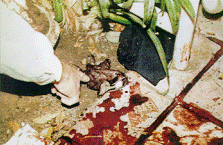 <![endif]>womans hand.
Fuhrman was the only person on Bundy who was photographed
pointing to the murders glovethe one he said Goldman pulled off of the
killers hand. That left-hand glove, as it lies palm-up near the fence on Bundy, says
nothing about the murderers identity. But it merges two images from separate realms
of time and s<![if !vml]>
<![endif]>womans hand.
Fuhrman was the only person on Bundy who was photographed
pointing to the murders glovethe one he said Goldman pulled off of the
killers hand. That left-hand glove, as it lies palm-up near the fence on Bundy, says
nothing about the murderers identity. But it merges two images from separate realms
of time and s<![if !vml]> <![endif]>pace to become a potent symbol for the right-hand glove near the fence on
O.J.s property when you learn that Fuhrman pointed it out to Lange and Vannatter.
That clearly establishes the significance of symbolism with Fuhrman and the
glovesmirror images of each other that call to mind the big hands O.J. was rumored
to have beaten Nicole with repeatedly until he killed her.
<![endif]>pace to become a potent symbol for the right-hand glove near the fence on
O.J.s property when you learn that Fuhrman pointed it out to Lange and Vannatter.
That clearly establishes the significance of symbolism with Fuhrman and the
glovesmirror images of each other that call to mind the big hands O.J. was rumored
to have beaten Nicole with repeatedly until he killed her.
One more thing about the hand in the movie and the gloves in real life: A severed hand can be expected to have had blood on it at the point of separation from the wrist. Thats where O.J.s blood from his left hand was found on the right-hand glove in the notch by the palm.
If thats not enough symbolism for you, think of all the things that a hand could stand for and how they apply to Fuhrman in the Bundy case:
For the first hour of the investigation, the fate of the case was in Fuhrmans hands.
When Vannatter and Lange took over, Fuhrman and Roberts stayed on to give them a hand.
Fuhrman and Roberts had a hand in every significant piece of evidence than anyone developed.
The center of Fuhrmans hand where he was photographed between Nicoles head and Goldmans feet marks the center of an 8" radius containing five key pieces of evidence, including the glove.
If Fuhrman was angling for a big hand from the American public with his star performance in the trial of the century, he got it.
The list goes on and on. Thats what makes dreams so hard to interpret. Without knowing everything a word, a phrase, a name or an object might stand for in the context of an individuals life, you cant be sure of what it might stand for in his dreams. A hand could be a hand. It could be something else, but the pattern, no matter how chaotic it may appear to be at first, follows its own internal logic. Sometimes it takes more than what is visible for everything that was there all along to click into place.
The first turning point in Jennifer 8 came with Berlin
clicking his lighter
<![if !vml]> <![endif]>and waiting outside for his partner inside a garage
to finish his work. It had to have struck a cord with Fuhrman if he saw it after the Bundy
killings. It had to have been an inspiration to him if he studied it beforehand.
The garage scene is where Berlin matched the red stop signal shaped like a hand to the
clicking noise that accompanied it to tell blind people when to stop for traffic. From
there, he went on to solve the crime.
<![endif]>and waiting outside for his partner inside a garage
to finish his work. It had to have struck a cord with Fuhrman if he saw it after the Bundy
killings. It had to have been an inspiration to him if he studied it beforehand.
The garage scene is where Berlin matched the red stop signal shaped like a hand to the
clicking noise that accompanied it to tell blind people when to stop for traffic. From
there, he went on to solve the crime.
Just because Fuhrman could have gotten ideas for planting evidence and ideas from Jennifer 8, doesnt mean he did, anymore than he had to have gotten other ideas from Jack the Ripper, Street Smart or The Bad Seed. But if you watch enough movies you know that somebody got some of those ideas from movies and injected them in whole or part into the crime scenes and the investigation of O.J. Simpson. We know that because those particular things were out of O.J.s zone of interests or control and they could not have materialized when and where they did by chance. The closer you get to Fuhrmans zone of interests and control in his best-known case the more specific the movie links to him become.
Nicoles bloodied dog led a neighbor to the murder scene at Bundy. Ron Goldman had several non-fatal cuts in his throat that the coroner characterized as "taunting" wounds. In Jennifer 8, the man in the dump had similar wounds. Berlins prompt, expert and certain identification of the killer made a real investigation impossible by anyone else. Fuhrman made all of the crucial discoveries in the Bundy case. He started much earlier than 1994 and the female victims bra with the AB blood type in Jennifer 8 is a good place to start rolling the time tape backward.
Before O.J. and Nicole divorced in 92 Fuhrman established himself as "Nicoles cop" with scores of police officers in various social settings. He talks about his "up close and personal" knowledge of her "boob job" coupled with tales of O.J. treating her like a punching bag and her deathly fear of him. All of that dovetailed nicely into the 89 New Years day incident where Nicole ran into officer John Edwards arms crying, "Hes going to kill me!" It had been raining. Her pants were dirty from where she fell in the mud. All she had on top was a bra. She told Edwards that O.J. kept a lot of guns and she feared he would shoot her.
It took Fuhrman to put a deadly weapon in O.J.s hands with his
tale of coming to Rockingham in 85 in his black and white squad car and
<![if !vml]> <![endif]>seeing
Nicole, O.J. and a Mercedes-Benz in circumstances that left "an indelible
impression" in his memory. He said that Nicole was sobbing and hinted that she was as
terrified of O.J. as Kathy Bakers character in Street Smart was of Fast Black
when he threatened to blind her in one eye (the murdered woman in Jennifer 8
was partially blind). In Fuhrmans report, the German car with the German
womans name sounded like a symbolic representation of the woman born in Germany that
O.J. identified as his wife the way Fast Black identified his whores.
<![endif]>seeing
Nicole, O.J. and a Mercedes-Benz in circumstances that left "an indelible
impression" in his memory. He said that Nicole was sobbing and hinted that she was as
terrified of O.J. as Kathy Bakers character in Street Smart was of Fast Black
when he threatened to blind her in one eye (the murdered woman in Jennifer 8
was partially blind). In Fuhrmans report, the German car with the German
womans name sounded like a symbolic representation of the woman born in Germany that
O.J. identified as his wife the way Fast Black identified his whores.
The accent on "his" comes mostly from the words
Fuhrman ascribed to O.J. speaking for a sobbing Nicole with a baseball bat in is hand. The
rest comes from  the
accent Fuhrman put on those words to make it sound as though O.J. regarded his beautiful
new bride as no less his property to do with as he pleased than his beautiful German car
with the broken glass. Lance Henriksen with a baseball bat in his hand as
Freddy
Ross in Jennifer 8 could rekindle thoughts of what O.J. might have done with
the bat. It might also bring to mind the fact that a baseball bat is sometimes called a
stick and in the course of playing the game the bat sometimes splinters
the
accent Fuhrman put on those words to make it sound as though O.J. regarded his beautiful
new bride as no less his property to do with as he pleased than his beautiful German car
with the broken glass. Lance Henriksen with a baseball bat in his hand as
Freddy
Ross in Jennifer 8 could rekindle thoughts of what O.J. might have done with
the bat. It might also bring to mind the fact that a baseball bat is sometimes called a
stick and in the course of playing the game the bat sometimes splinters
In that sense, the bat Fuhrman said he saw in O.J.s hands and the freshly splinter piece of wood that Fuhrman said O.J. snagged under his Bronco are like the glove he pointed to on Bundy and the one he found on Rockingham. The two objects from separate times and places come together in the mind with little or no conscious thought the way images from Nicoles "battered face" in 89 came together with the sound of her frightened voice in 93. None of that could have happened without Mark Fuhrmans 1989letter to the Brentwood city attorney.
The power in that letter has less to do with his heavy-handed use of incriminating "quotes" than his repetition of memorable themes and his subtle way of suggesting things he wants you to believe without actually saying them. Hes got that trick down cold and uses it with great effect.
If you heard Fuhrmans trial testimony, for example, you might swear that you heard him say he left the Police Protective League Picnic on the 12th of June shortly before 8:00 P.M. If you read his book, youd swear he wrote that O.J. showed up at Nicoles shortly after 10:00. He actually said he left the picnic "before" 8:00which could have been 24 hours before 8:00 without a polygraph needle getting ugly about it. He hypothesized that Nicole spotted O.J. in the alley sometime "after 10:00," which covers any start time from 10:01 to 10:50.
The trick is to frame the issue in such a way that people expect to hear or see a close approximation of the time. A minor variation of the trick is to answer a question where an approximate time is expected with a vague generalization that seems at the time to do the job. If someone says "after 10:00 in that situation as opposed to saying "10:00 or 10:15, " you may have heard it correctly but you are not likely to remember it that way for long. The big thing was ten, so thats what you recall. The more you think about it the more certain you are likely to be in your false memory.
In the early 70s a popular psychology magazine published a study about that false recall phenomenon. The study was conducted by Gordon W. Allport, the author of The Nature of Prejudice. Allport showed a test group pictures like the ones below and asked them to duplicate from memory what they had seen.

<![if !vml]> <![endif]>
Most people were able to do it right after viewing them. However, as time passed, their memories filled in more of what the shapes suggested to them from previous experience. They gradually filtered out little things that didnt compute until 80% of the subjects recalled seeing this:

You may not recall the gaps in Fuhrmans case against O.J. because memory gravitates to the familiar and the extreme. Thats one of the principles underlying the power of stereotypes. The pictures are already fixed in our minds. We need only to see enough to remind us of them.
Recalling the last three digits of the Mercedes California license
plate in <![if !vml]> <![endif]>Jennifer 8, watch for the "big
things" in Fuhrmans letter to the city attorney
.
<![endif]>Jennifer 8, watch for the "big
things" in Fuhrmans letter to the city attorney
.
"During the fall or winter of 1985 I responded to a 415 family dispute at 360 North Rockingham. Upon arrival I observed two persons in the front of the estate, a black male pacing on the driveway and a white female sitting on a vehicle crying. I inquired if the persons I observed were the residents, at which time the black male stated, "Yeah, I own this, Im O.J. Simpson!" My attention turned to the female who was sobbing and asked her if she was alright but before she could speak the black male (Simpson) interrupted saying, "shes my wife, shes okay!" During my conversation with the female I noted that she was sitting in front of a shattered windshield (Mercedes-Benz, I believe) and I asked, "who broke the windshield?" with the female responding, "he did (pointing to Simpson) He hit the windshield with the baseball bat!" Upon hearing the females statement, Simpson exclaimed, "I broke the windshield its mine theres no trouble here." I turned to the female and asked if she would like to make a report and she stated, no.
"It seems odd to remember such an event, but it is not every day that you respond to a celebritys home for a family dispute. For this reason this incident was indelibly pressed on my memory."
Did you catch the line Officer John Edwards used to quote O.J.s housekeeper when he asked about the woman who was being beaten? Whether it originated with Edwards or Fuhrman, the familiar note it sounded tied the "Hes going to kill me" incident to the baseball bat and "shattered" windshield incident like nothing else could have, except the false report that Fuhrman was called to Rockingham on a "415."
Take a hard look at the facts of that report, such as they are, and see where you can find any violence or threats of violence against Nicole that arent dependent on imagery called up by Fuhrmans choice of words. Consider the "shattered" windshield he didnt notice until he started conversing with Nicole. The word suggests a powerful swing of the bat by a murderously angry man. The picture of that man formed automatically in your mind is what stickslike the scene in Street Smart, where Morgan Freeman, breaks a glass bottle inside of his car and uses the jagged edge to terrorize one of his women. Or did the early repetition of "black male" and the one mention of "white female" sound more like Morgan and Kathy on a movie screen than O.J. and Nicole in the flesh?
Kathy Baker, who also starred in the TV series Picket Fences, happened to have a part in Jennifer 8. She played the wife of Freddy Ross, the man with the baseball bat.
So far I havent mentioned Andy Garcia, the actor who plays John Berlin. In Dead Again, he plays a reporter named Gray Baker, a role that links him to three other movies from which the Bundy murders borrow a considerable amount: Double Indemnity, The Naked Gun, and The Pelican Brief. In The Pelican Brief, the leading character is a reporter named Gray Granthem. The Naked Gun and Double Indemnity are joined together by an anklet. Looking at the movies like a map of the brain with physical connections from one idea to the next I found the name Andy making the connections more often than youd think.
Andy was the little boy in Childs Play menaced by the evil spirit of Chucky in a Good Guy doll. He lived in Chicago was where O.J. went after the killings, where Ted Bundy went after he escaped from jail and where the urban legend of Candyman was bornaccording to the movies. But the most interesting thing to me is what Andy Garcia had in common with Elizabeth Shue, Michael Caine, Michael Keaton, Michael J. Fox, Faye Dunaway, Teressa Russle, Clint Eastwood, Sharon Stone, Tony Todd, Carl Withers, Patty McCormick, James Woods, and O.J. Simpson? The answer: Mark Fuhrman
Think of the Candyman jigsaw puzzle with its six interlocking
connections to the opening scene of Fuhrmans Bundy scenario. A beautiful blond in
the picture gives you nothing. The blond on a phone gives you very little and the blond on
a phone in the kitchen doesnt give you much more. But when you put a knife in her
hand identical to the one on Nicoles kitchen counter, the meaning meter starts to
register faint traces of a connection to Fuhrmans limited imagination. The tall,
black, obsessed, stalker, killer ex behind her in the background with the strange clothes
would be enough to wrap it up, but theres more. The mans sharp hook in place
of a missing knife g ives you two for one, a good symbolic representation of the murder
weapon and a missing leather glove with the killers own blood on it.
ives you two for one, a good symbolic representation of the murder
weapon and a missing leather glove with the killers own blood on it.
If it did happen that way in Nicoles condo on the 12th of June 1994, to see it as clearly as Fuhrman did youd have to have the psychic Eyes of Laura Mars.