


|
|
|
|
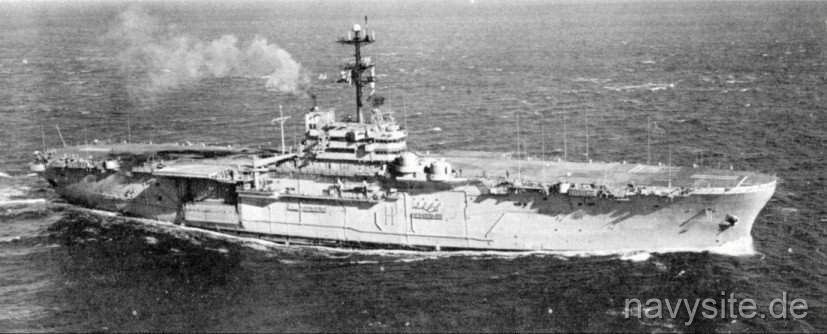
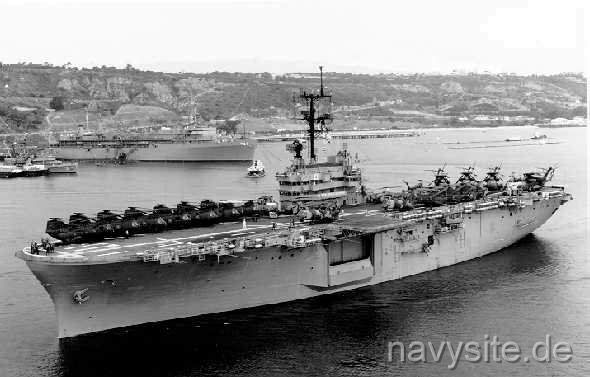
USS NEW ORLEANS was the sixth IWO JIMA - class amphibious assault ship (helicopter) and the fourth ship in the Navy to bear the name. Decommissioned on October 1, 1997, and stricken from the Navy list on October 23, 1998, NEW ORLEANS is now laid up at the Suisun Bay Reserve Fleet, Benecia, Ca., and is scheduled to be sunk as a target.
| General Characteristics: | Awarded: December 18, 1964 |
| Keel laid: March 1, 1966 | |
| Launched: February 3, 1968 | |
| Commissioned: November 16, 1968 | |
| Decommissioned: October 1, 1997 | |
| Builder: Philadelphia Naval Shipyard, Philadelphia, Penn. | |
| Propulsion system: Two boilers, one geared steam turbines, one shaft, 22,000 total shaft horsepower | |
| Propellers: one | |
| Length: 603, 65 feet (184 meters) | |
| Beam: 104 feet (31.7 meters) | |
| Draft: 25,9 feet (7.9 meters) | |
| Aircraft elevators: two | |
| Displacement: approx. 19,500 tons full load | |
| Speed: 23 knots | |
| Aircraft: 20 UH-46D Sea Knight Helicopters, 10 MH-53E Sea Stallion Helicopters, 3 UH-1 Helicopters, 3 AH-1 Helicopters but the actual mix depends upon mission | |
| Armament: two Phalanx CIWS, two Mk-25 Sea Sparrow Missile Launchers | |
| Crew: 80 officers, 638 enlisted, 1,750 Marine Detachment |
 back
to top
back
to top  go
to the end of the page
go
to the end of the pageCrew List:
This section contains the names of sailors who served aboard USS NEW ORLEANS. It
is no official listing but contains the names of sailors who submitted their
information.
back
to top go
to the end of the page
Accidents aboard USS NEW ORLEANS:
| Date | Where | Events |
|---|---|---|
| February 29, 1976 | Pacific Ocean |
While crossing from the western Pacific to San Diego, Ca., USS NEW
ORLEANS suffers vibrations at speeds above 10 knots. It is
discovered that one blade from the four-bladed screw is missing. On
March 2, NEW ORLEANS alters its course from San Diego to Hawaii as
the damage impedes its progress.
|
back
to top go
to the end of the page
USS NEW ORLEANS History:
 USS
NEW ORLEANS was laid down on March 1, 1966 at the Philadelphia Naval Shipyard in
Philadelphia, Pennsylvania. She was launched on February 3, 1968 and sponsored
by Mrs. Arthur A. De la Houssaye. She was commissioned on November 16, 1968 with
Captain G.M. Even in command.
USS
NEW ORLEANS was laid down on March 1, 1966 at the Philadelphia Naval Shipyard in
Philadelphia, Pennsylvania. She was launched on February 3, 1968 and sponsored
by Mrs. Arthur A. De la Houssaye. She was commissioned on November 16, 1968 with
Captain G.M. Even in command.
NEW ORLEANS made her first appearance in the Western Pacific in August of 1969
as flagship for Amphibious Ready Group Bravo. Her embarked Marine helicopter
squadron and battalion leading team were ready to be landed within hours. In
October, she hosted the Eighth Vietnamese Awards. Later that month, she
participated in Keystone Cardinal Operation, a retrograde movement of Marines
out of Vietnam. The ship's first deployment terminated in March of 1970. After
having participated in five amphibious exercises, conducted many weeks of
Amphibious Ready Group (ARG) maneuvers in the South China Sea, and visiting such
ports as Hong Kong, Manila, Subic Bay, Okinawa, and Taipei, NEW ORLEANS returned
to San Diego.
Two other interesting assignments were given to NEW ORLEANS prior to her next
Western Pacific deployment. In August of 1970, she became flagship for Commander
First Fleet and provided support for President Richard Nixon's visit to Puerto
Vallarta, Mexico, and made a port call to Acapulco. Then, in late 1970, she
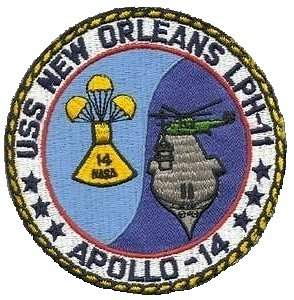
prepared for the recovery of
Apollo 14. On February 9, 1971, she picked up
astronauts Alan Shepard, Stuart Roosa, and Ed Mitchell some 900 miles south of
American Samoa.
In May of 1971, NEW ORLEANS made her second Western Pacific appearance,
conducting various contingency exercises, a multi-national cruising exercise
simulating a convoy under combat conditions, and a simulated assault with the
Marines on the island of Mindoro, Republic of the Philippines. This deployment
was completed in November of that same year.
Following a rather extensive yard period, NEW ORLEANS began her next Western
Pacific deployment on July 17, 1972 under the command of Captain R.W. Carius.
She became flagship for Amphibious Squadron Three and later Amphibious Ready
Group Alfa under Commodore W.H. Ellis. During late July and early August, NEW
ORLEANS and her embarked units participated in the Philippine flood relief
operations, earning the Philippine Presidential Unit Citation.
The helicopter carrier became engaged in contingency operations again with the
ready group off the coast of Vietnam until early February of 1973, at which time
she became the flagship for Commander Task Force 78 and the control ship for
Operation End Sweep. CTF 78, headed by Rear Admiral Brian McCauley, was tasked
with de-mining operations for the coast and harbors of North Vietnam. She ceased
operations in Haiphong Harbor on April 17, 1973.
 NEW
ORLEANS next participated in recovery operations for the Skylab II and Skylab
III missions. She was also present for the recovery of astronauts Stafford,
Slayton, and Brand during the joint American-Soviet Apollo-Soyuz mission of July
5, 1975.
NEW
ORLEANS next participated in recovery operations for the Skylab II and Skylab
III missions. She was also present for the recovery of astronauts Stafford,
Slayton, and Brand during the joint American-Soviet Apollo-Soyuz mission of July
5, 1975.
In 1980, the ship deployed and spent several months in the Indian Ocean during
the Iran hostage crisis. She completed a major overhaul at Bremerton Naval
Shipyard in 1981. Deployments and exercises in 1982 and 1983 included RIMPAC
'82, Exercise Kernel Usher '83-1, and WESTPAC '83. From May to December of 1984,
NEW ORLEANS sailed the Indian Ocean and Western Pacific, participating in eight
major amphibious operations. While on WESTPAC in 1986, she served in an alert
status off the Philippine coast during that country's national elections. She
also served as the medical and communications support ship for President Ronald
Reagan's trip to Bali, Indonesia.
Upon her return to home port, NEW ORLEANS participated in two major exercises
leading to her thirteenth deployment to the Western Pacific. During this time,
she participated in four amphibious exercises, including Cobra Gold '88, Valiant
Usher '89-1, and Valiant Blitz '89-1. The ship called on the port of Perth,
Australia, during that country's bicentennial. In 1989, she made port visits to
Mazatlan, Mexico, and Seattle, Washington, for the Seattle Sea Fair. She also
conducted a humanitarian relief effort in Cabo San Lucas, Mexico.
Following completion of a phased maintenance availability in January of 1990,
NEW ORLEANS sailed the Western Pacific, Indian Ocean, and Persian Gulf in
support of Operations Desert Storm and Desert Shield from December 1, 1990 to
August 28, 1991. She served as a member of CTG-36/CTF-156, the largest
amphibious task force to deploy from the West Coast of the United States in 25
years. Significant accomplishments included the off-load of 1,700 Marine combat
troops on G-Day and aviation mine countermeasures in the North Arabian Gulf, ten
nautical miles off the coast of Kuwait.
In November of 1991, NEW ORLEANS returned to San Diego for a six month overhaul.
In October of 1992, she hosted festivities at Fleet Week '92 in San Francisco.
After returning to San Diego, she was the first LPH to go through Afloat
Training Group Pacific's "Tailored Ship's Training Availability" and was
instrumental in developing a training track for LPH-class ships. In September of
1993, NEW ORLEANS deployed on her fifteenth WESTPAC cruise where she
participated in Exercise Valiant Usher '93 and was a member of the Amphibious
Ready Group that conducted operations in support of Operation Restore Hope at
Mogadishu, Somalia.
LPH 11 next sailed onto the movie screen in November of 1994 when astronaut
Captain Jim Lovell, USN, director Ron Howard, and actors Tom Hanks, Kevin Bacon,
and Bill Paxton came aboard to film several portions of the Oscar-winning movie
"Apollo 13."
June of 1995 saw NEW ORLEANS underway again for WESTPAC operations. She was
present to support the Marine raid on the Al Hamra Facility on October 24 of
that year. She returned to San Diego on December 22, 1995, after embarking 198
Sea Scouts as part of a "Tiger Cruise" during the last leg of her journey from
Pearl Harbor to San Diego. The ship got underway again on January 31, 1997, for
another WESTPAC cruise before returning to port on May 2.
NEW ORLEANS was decommissioned and placed in reserve in San Diego,California, in
October of 1997. She was the proud recipient of the Navy Unit Commendation, four
Battle Efficiency Awards, the Meritorious Unit Commendation, the Navy
Expeditionary Medal, the Armed Forces Expeditionary Medal, the Southwest Asia
Campaign Medal, the Vietnam Service Medal, and the Kuwait Liberation Medal.
back
to top go
to the end of the page
USS NEW ORLEANS Patch Gallery:
 |
back
to top go
to the end of the page
USS NEW ORLEANS Image Gallery:
 |
 |
|
back
to top Back to Amphibious Assault Ships
list. Back
to Ships list. Back
to Selection Page. Back
to 1st Page.
Back to Amphibious Assault Ships
list. Back
to Ships list. Back
to Selection Page. Back
to 1st Page.